Life line
Arc, visibility and continuity. Never used to infer lifespan or illness.
Photograph your palm and explore the life, head, heart and fate lines through a careful traditional lens. Your image stays in this browser.
This reading follows the fixed traditional male-left, female-right convention.
Natural light helps, but an ordinary hand photo is fine. Keep the palm reasonably visible.
Comparing line contrast, continuity and balance.
A single front-facing photo can support broad visual observations. Side-edge relationship lines, skin temperature, flexibility and subtle three-dimensional mounts cannot be judged reliably from that image.
Arc, visibility and continuity. Never used to infer lifespan or illness.
Compared as traditional symbols of decision style and emotional expression.
Read as reflective themes for direction, craft and recognition, not guaranteed outcomes.
Visible texture and overall proportion add context without claiming biometric identity.
This experience follows the fixed traditional convention: male-left and female-right. Men are read from the left palm and women from the right palm.
No. This version performs its image checks and reading in your browser. The tool does not send your palm photo to an API, and refreshing or closing the page clears it from the experience.
No. A life line does not measure lifespan, and a photo cannot diagnose health or guarantee money. Treat the reading as a cultural prompt for reflection.
BaZi constructs Four Pillars from your birth date and time. Palmistry interprets visible hand features. They are separate traditional systems: BaZi offers a time-based framework, while this tool offers a present visual reflection. One does not verify the other.
Read the lines with context
Explore the major lines, hand-selection customs, and the difference between Chinese palm reading and Western chiromancy before you interpret a photograph. This is a cultural framework for reflection, not a scientific diagnosis or a promise about the future.
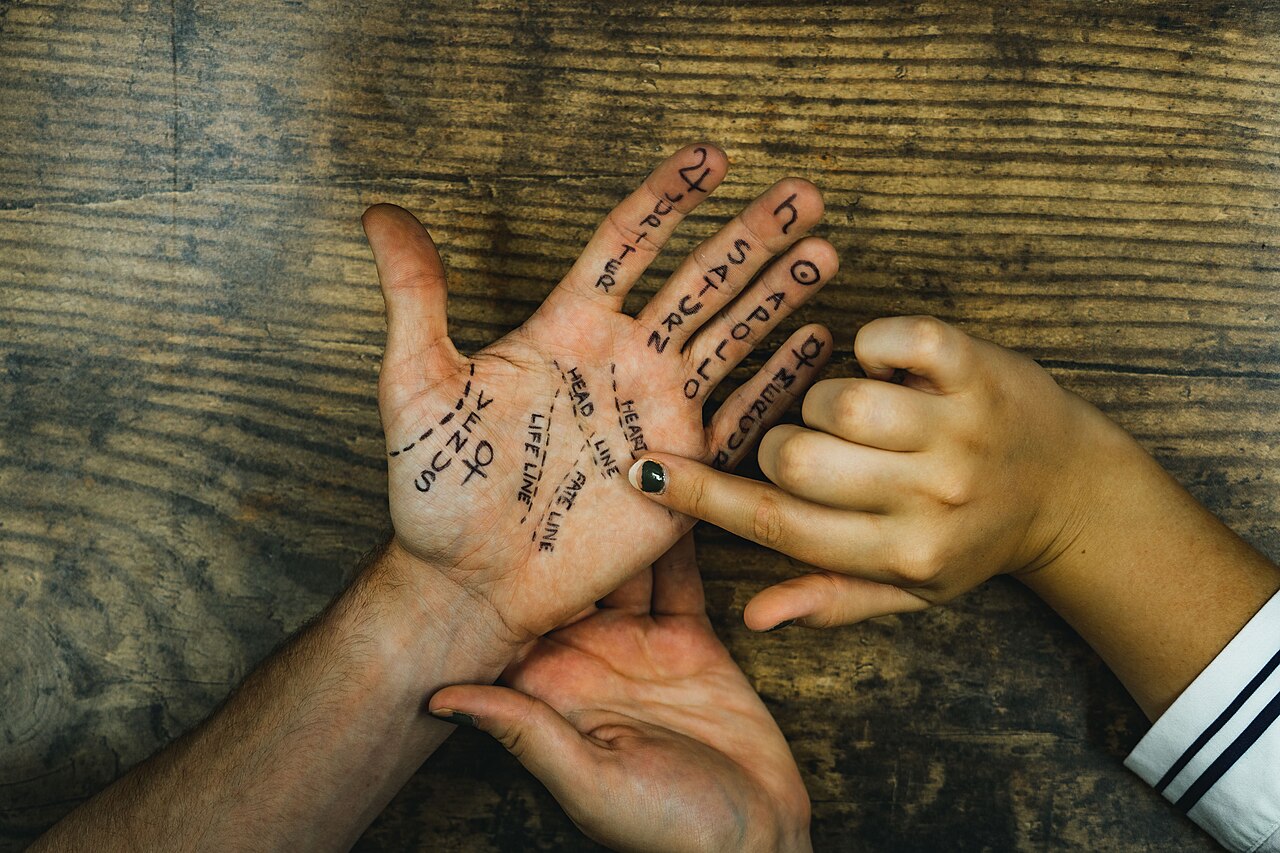
The life line curves around the base of the thumb toward the wrist. In traditional palmistry it is associated with vitality, grounding, physical rhythm, and the way someone responds to changes in their environment. It is not a countdown clock and does not measure how long a person will live.
A long, clearly traced arc is often described as steady reserves or a strong attachment to familiar places. A shorter line can simply reflect the angle of a photograph or a different hand shape; traditional readers may instead look at its depth and supporting markings. Breaks, islands, and small branches are interpreted as periods of transition, rest, travel, or renewed direction, not as illness.
The head line runs across the middle of the palm and is also called the Wisdom Line in some English-language guides. Traditionally it represents attention, learning style, judgment, and the balance between practical reasoning and imagination. A relatively straight line is often read as focused and methodical, while a gentle slope is associated with visual thinking or a reflective mind.
Length is considered alongside clarity: a long line may suggest sustained concentration, but it does not prove intelligence. A visible fork can symbolize an ability to hold two viewpoints, and a soft break may be read as a change in study, work, or priorities. These are symbolic observations, not personality tests; lighting, skin texture, and camera angle can change what appears visible.
The heart line sits below the fingers and is often called the Love Line. In the traditional vocabulary it relates to emotional expression, affection, trust, and the way a person seeks closeness. A clear, gently curved line may be described as open-hearted, while a straighter line is sometimes linked with a more measured way of showing care.
Readers may note whether the line reaches toward the index finger, middle finger, or the space between them, but no position guarantees a relationship outcome. A fork near the end can represent nuance or an ability to balance feeling with reason. Small breaks or cross-lines are treated as chapters of emotional learning, never as proof of heartbreak, diagnosis, or a fixed destiny.
Traditional Chinese palm reading considers the three major lines together with the fate line, sun line, thumb, fingers, mounts, and overall palm shape. The fate line is commonly discussed as a sense of direction or changing responsibility; the sun line as craft, pleasure, or recognition. Their absence is ordinary and carries no negative verdict.
Hand proportions and flexible or firm fingers provide context for the lines, yet a single phone image cannot show depth, temperature, or movement reliably. This tool therefore focuses on broad, visible features and explains the traditional association beside each observation. Treat the result like a journaling prompt: useful for asking what feels true today, not for outsourcing a choice.
Chinese palm reading (手相, shǒuxiàng) developed alongside other systems of character observation and often reads the palm shape, finger joints, mounts, and lines as one connected picture. Western chiromancy commonly gives more attention to named lines, their mounts, and a hand's elemental type, with its own vocabulary and historical schools. Neither tradition has a single fixed method, and practitioners may disagree about the same crease.
MyBaziDestiny uses a restrained blend: traditional Chinese references provide the cultural lens, while an instant photo check keeps the experience concrete and transparent. The browser identifies visible contrast and continuity; it does not claim to identify a person or reveal hidden facts. Comparing the two perspectives can be interesting, but it should not turn a symbolic reading into a medical, legal, or financial conclusion.
That distinction is useful when reading online. A camera can show a dark groove, a pale ridge, or a fork that catches the light, but it cannot establish when a change happened or what caused it. Traditional language gives those shapes a theme; careful wording keeps the theme proportional to the evidence. The best result is therefore specific about what is visible and open about what remains unknown.
This page uses one fixed traditional convention: men are read from the left palm and women are read from the right palm. The gender choice determines the representative hand automatically, so there is no second-hand selection or comparison step in this experience.
Keep the entire selected palm and all five fingers in frame, use even light, and avoid a heavy filter. A clean image makes line continuity easier to discuss, but it cannot make the interpretation objective. The tool's guidance stays within traditional symbolism and should be read with curiosity and healthy skepticism.
For a repeat reading, use similar lighting and distance so that changes in the image do not look like changes in the hand. You can save the result as a reflection note and return later, but do not use a line comparison to monitor health or make a high-stakes decision. The point of the exercise is to notice a story you can question, not to hand authority to a crease.
Keep exploring: review the MyBaziDestiny methodology, compare this visual tradition with a Four Pillars chart, or browse the cultural reading guide.
This experience follows the traditional male-left, female-right convention: men are read from the left palm and women from the right palm.
No. The photo is processed locally in your browser and is not sent to a server by the palm-reading tool.
No. Line length is not a measure of lifespan and palmistry should not be used for medical conclusions. This experience is for cultural interest and self-reflection only.
BaZi uses birth date and time to construct the Four Pillars. Palmistry interprets visible hand features. They are separate traditional frameworks.
In traditional palmistry, the life line is read as a symbol of vitality, grounding, and the way a person meets change. Its length does not predict lifespan, and a photograph cannot provide a medical conclusion.
This page uses one fixed convention: men are read from the left palm and women are read from the right palm. There is no second-hand selection in this experience.
Palm reading is a traditional interpretive framework and a form of cultural exploration, not a scientific test. Use it for reflection and conversation, never as medical advice or the sole basis for an important decision.
Start with a clear photo of the full palm, then use this tool to check visible line patterns and read the traditional explanations. The result is a broad visual prompt, not a complete in-person palmistry consultation.